
Sunday, November 4, 2007

Interview with Chris

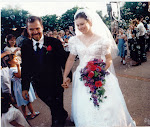
Ladies and Gentlemen, your future pastor!


I moved to Colorado in 1991. My pattern has always been to find a few good friends and stick with those guys. In San Diego I was close to a neighbor named Daniel; in Virginia I met Wally (and later Alex); and in Colorado I met Chris, Tom, James, Book and Baggs. I'll stick to first names and nicknames to protect the innocent.


In Colorado, I pretty well latched onto one group of great guys, made a few additions in college and law school, and haven't looked back. We all went to high school together (except Baggs, who I met at CU) and have remained tight for many years. Just Friday night, four of us sat down and discussed how we all met and talked about some of the good old days.


Things change with time. People move, get married, etc. Chris is studying at Seminary School in Iowa and stopped by for a visit. He stayed at our hotel (i.e. basement) while in town for a wedding. As usual, he had a busy schedule, but I managed to grab hold of him for a few discussions.


Chris passed through town this weekend. You can find his musings by clicking on the "ganglylove" link on this page. I met Chris not long after moving to Colorado from Virginia and he and Tom were the first two friends I made here. I originally intended to create a "mutual post" in a conversation format, but it just felt better having one of our usual conversations and trying to summarize it.


You might say that I sat down with Chris for an impromptu interview Sunday night. My notes are scattered, but I attempt to reconstruct it the best I can. The rest I will summarize from memory. My dad always told me I made good decisions in picking friends, and I always took that as a big compliment. I have the greatest group of friends a guy could have and thought it would be fun to give the reader a taste of what we talk about and how we interact.


Chris is my Guinea pig.


Chris is in the second of three years for Seminary School and will be a full-fledged pastor when it's all said and done. Unfortunately for us, we're not sure he'll ever live close again. But, we hold out hopes.


ON COLORADO AND FRIENDS


Can we expect you back in Colorado?


"I don't know. As far as permanently, No. I hope I can come back, but to pin hopes and dreams on that is not reality. I like that I am in a place in life where my life is an open door. "


You don't have many reasons to come back here locally now that your mom is in Arizona and your dad is in Denver. I don't imagine we'll be seeing you too many more times for these visits.


"Someone once said that the family you are born into is there to prepare you for the family you eventually become a part of. I think we spend most of life with the community we surround yourself with as adults. I have grown to consider my friends like family. I always love spending time with close friends from my life."


You think that even though I used you for your car in High School? I mean, I needed a ride home and you were convenient.


"Hey, I used you for your video game system (Sega Genesis). You think I would have given you a ride if you didn't have a video game system? You think I'm that nice?"


Not really. Afterall, I had to worry whether your piece of junk would get me home in one piece. What kind of car was that anyway? I mean, it had a coat-hanger keeping the muffler on.


"It was a Grenada. 1981 Ford Grenada. The clothes-hanger was probably from 1993."


Some find it weird for high school buddies to stay so tight for so long. Thoughts?


"Most people meet friends for life in college. For me, I went to college at home. Tom, Dave, and James were still around... still close. That's probably why none of us made too many college friends. Although you were tight with Baggs and he's kinda become like the 6th Beatle. It was kinda instantaneous with him."

You were social butterfly in high school.

"I was never all that popular. I had 2 or 3 distinct groups. I helped lead James over to you guys. I had various groups of friends."


ON HANGING OUT / WORK


Free rides for video game fodder, that was a good deal for me.


"I will always remember 'Barkley for three!' (NOTE: video Charles Barkley beat Chris at the last second with an inconceivable three-pointer that sent Chris to the floor with grief circa 1992). We also played a lot of Joe Montana Football and Goldeneye. Those were some real fun times. I loved the 'one shot, one kill' settings on Goldeneye."


Your mom probably wondered what happened to you in those days.


"Mom always wondering where I was. She spent a lot of life wondering that. She worked and I worked."


Speaking of which, it was you who got me my job at KFC.


"Will you ever forgive me for getting you a job there? Then again, you owe me for getting you a job there. You owe me, because if you hadn't gotten a job there you wouldn't have that little guy on your lap there (little Jacob). You wouldn't have met that wonderful wife of yours."


I don't know if you remember, but you were taking me to a Rockies game when I first saw Jen. We stopped at KFC for free drinks for the road when she served me a Pepsi. I had worked at KFC the previous summer and was getting ready to start that summer (1995) as well. I made note to find out more about the cute one who fixed my drink. You gave me the 4-1-1. My first question was, 'how old is she.'


"I knew she was an engineering major at CSU."


I was secretly happy that she was in my age range because she looked possibly too young. I was glad she was my age.


"As opposed to the 17-year-old you asked for the under-12 buffet?"


Yeah, you will never let me live that down! That girl looked 12.


The pranks were the best there.


"I still remember throwing the roto-bird to you. 'Joe, go deep.' April (the manager) was so relieved when you caught it... until you spiked it on the floor."


Do you still do pranks at Seminary?


"I took the doorknob off a friend's door, turned it backwards and then was able to lock her in her room. But, she had actually done me a favor earlier that I wasn't aware of at the time, so I felt bad about that one."


"She got back at me by putting Rainbows and 'Just Married' on the windows of my car when Me and Ryan were going to drive to Colorado. We cleared that off before leaving."


ON SEMINARY SCHOOL


How has school changed the way you think?


"It has challenged the way I think, but given me a lot of answers to why I believe what I believe. It takes the blinders off of my faith. Also, it's helpful to learn of the history and how the bible was translated."


Has the process changed any beliefs?


"I know there has been some change, but can't say exactly what off the top of my head. I have a deeper feeling that community is more important now than before. Communal faith as well. Specifically First Corinthians."


NOTES


As usual, our conversation took many other turns after I stopped taking notes. We talked about how we have all changed and grown and how each of us have gone through a variety of life experiences.


We talked about how life is like a movie; how fun it was for the others to try to get me to drink when I was dead-set against it; how none of us made any of the parents nervous or suspicious and just how much fun it was growing up together. It was fun to look back on that and to once again talk into the wee hours about life. I never get over new perspectives on old memories. Chris' theory about my loosening up was that I finally learned to "come out from your dad's shadow." Only tight friends can make such observations.


Chris likes to say he'll always have a lawyer, and I think I've found my pastor. So, I guess you could stay, we're still just using each other. First it was video games and beat-up cars, now professional services. Can't beat it.

Sunday, October 21, 2007

Examined Life

"The unexamined life is not worth living."
- Socrates

It has been said that great books, if they are truly great, change your life. Without any contemplation, I can name two such books.

Brave New World by Aldous Huxley inspired me to turn off the television (or at least limit its demand on my time) and pick up productive hobbies.

But no book changed my life quite like the Autobiography of Benjamin Franklin. It is more than a biography, but a road map to an examined life written by one of the most remarkable people in world history.

I believe that examination of life and the resulting changes in habit lead to happiness and virtue. I do not advocate the substitution of Benjamin Franklin for the chosen religious text of the reader. But there is no source for life view that will not benefit from the road map provided by Mr. Franklin. It is an example of how to be virtuous in our organic world. From his attempt at perfection through 13 daily rules to the examples of an altered life, I present it all to advocate an examined life.

Try to be a better parent, better friend, better sibling, better professional or a better and more honest citizen than you were yesterday.

Anyone who reads the autobiography will see that it was no accident Benjamin Franklin lived one of the most thoroughly successful lives ever (although success comes in all shapes and sizes). He won international fame for his scientific discoveries, donated inventions to public use (rather than profit from the patent), negotiated alliances and peace and accomplished more than I can justly list here. His most impressive quality to me, however, was a willingness to diagnose and treat his own life in ways that added virtue. More so than accomplishing impressive feats, Ben Franklin accomplished in life by doing things the right way. I am more impressed with his use of celebrity to bring the issue of abolishing slavery before the very first US Congress than by his discovery of electricity or his mapping of oceanic currents. I respect that more because it was the right thing to do and the decision was steeped in integrity.

When I revisited the autobiography I discovered that my motivations for this blog were similar to Franklin's motivation for his autobiography. I do not intend to write an autobiography, and I do not bring the stature of a founding father to the discussion, but both of us were motivated by a desire to communicate lessons learned to a son.

Like him, I strive to show my son that anything worth doing is worth doing honestly.

Franklin's book starts with "Dear Son," and includes this explanation:

"I have ever had a pleasure in obtaining any little anecdotes of my ancestors. You may remember the enquiries I made among the remains of my relations when you were with me in England and the journey I undertook for that purpose. Imagining it may be equally agreeable to you to know the circumstances of my life - many of which you are yet unacquainted with - and expecting a week's uninterrupted leisure in my present country retirement, I sit down to write them for you. "

No one is capable of perfection, but anyone can benefit from the steps taken by a man who ventured far closer to it than most others.

THE THIRTEEN VIRTUES

Happiness seems to come from peace of mind. Franklin's 13 virtues assist in obtaining peace of mind.

It is a legendary story that Franklin attempted to fulfill each of these 13 virtues every day and famously kept a checklist for that purpose. However, he acknowledged that the task was impossible and soon gave it up. After all, we are all fallible beings. Although perfection is impossible, idleness regarding virtue will not further happiness. Just like the mathematical formula that always approaches zero without ever touching it, so will we always strive for the unattainable.

For me, anyone who believes that what we do on earth matters must conclude that how we conduct ourselves must also matter. With that in mind, I give you Franklin's 13 virtues (and a few of my comments):

1. Temperance: Eat not to dullness. Drink not to elevation.

2. Silence: Speak not but what may benefit others or yourself. Avoid trifling conversation. (I add to make it a point to defend those not present or unable to defend themselves.)

3. Order: Let all your things have their places. Let each part of your business have its time.

4. Resolution: Resolve to perform what you ought. Perform without fail what you resolve.

5. Frugality: Make no expense but to do good to others or yourself, i.e. waste nothing.

6. Industry: Lose no time. Be always employed in something useful. Cut off all unnecessary actions. (Make family time more precious than professional time)

7. Sincerity: Use no hurtful deceit. Think innocently and justly; if you speak, speak accordingly.

8. Justice: Wrong none by doing injuries or omitting the benefits that are your duty.

9. Moderation: Avoid Extremes. Forebear resenting injuries so much as you think they deserve. (Hold no grudge)

10. Cleanliness: Tolerate no uncleanliness in body, clothes or habitation.

11. Tranquility: Be not disturbed at trifles or at accidents common or unavoidable. (Bring none of those trifles to bed at night)

12. Chastity: Rarely use venery but for health or offspring - never to dullness, weakness or the injury of your own or an other's peace or reputation.

13. Humility: Imitate Jesus and Socrates. (Be faithful, but not judgmentally so).

Quite a list. Even Franklin failed famously at some of those. But, given that some failures are to be expected, it is important that a person be mindful of the goal.

I have made my own alterations to this list (beyond just my comments), and I imagine there are as many varieties of lists as there are people based on personality, desires, values, strengths and weaknesses. The important part is to have a list at all. Unfortunately all too few are willing. After all, in Franklin's words "How few there are who have courage enough to own their own faults, or resolution enough to mend them!"

EXAMPLE

My favorite example of an examined life in action came when Franklin, a young man, decided to change his whole approach to argumentation. The story goes that Franklin often found himself and his arguments dismissed because he brought arrogance and stubbornness to the discussion. The book goes through his analysis of himself as he decides to add phrases such as, "you make an interesting point, but have you considered.....?"

Franklin notes that by listening, communicating with respect and softening the blow of a factual or argument correction, he could show his point on the merits. Shouting and pounding on the table, however, served to halt all listening and set the listener to argue against even the most well founded points for the sake of dragon slaying. This is just one small part of life, yet it warranted the attention of Mr. Franklin because it was on his mind.

How a life is examined may be determined by the examiner, so long as the process happens.

The Autobiography is very short. It ends abruptly because Franklin died before its completion. Still, I feel it is important to learn from those who came before us. It goes without saying that I strongly recommend the book to anyone who contemplates the merits of an examined life.

Wednesday, October 3, 2007

Jacob!

Finally, I have pictures of Jacob to share! And, as a bonus, they are all very recent.

I can't really describe how this little guy has changed our lives. Of course, I can only speak for myself. There was a time in my life when goals and advancement were much more important. Then came Jacob. My number one goal in life now is to maximize my time with him.
He says "cheese" and "Please" and a number of other words that he speaks with varrying frequency. I hope you enjoy these photos of our little guy.


What a flirt. The shirt says it all!


Playing Peekaboo


Jacob with Dad


By the way... he can climb!


NOTES: I have tried a few times to post a short video of Jacob at the park, but so far cannot get Blogger to upload the video. I'll have to play with that some more.
OTHER NOTES: I am now half-way through "Fiasco." Just like Seth, who posted on my first Iraq post, I am at a loss for words to see just how badly this military campaign was bungled. Unlike the political books I've read to this point (like "State of Denial") this one goes through the nuts and bolts failures of implementation. What a read. I recommend it strongly, but make sure you are ready for outrage.

Saturday, September 15, 2007

Surge Ahead

Just like everyone, I was anxious to hear what General Patreaus would report to the nation on September 11, 2007. Unfortunately, by that scheduling timetable, someone decided once again to make a subtle gesture to try to link 9/11 to Iraq when no rationally-thinking humans left in this world can make any such connection. To quote George Tenant from page 341 of his book "Let me say it again: CIA found absolutely no linkage between Saddam and 9/11." That has been communicated TO the President, BY the President and still some choose to believe this (apparently because it comforts them).

This argument is over. There is no connection. All supposed connection theories and allegations have been proven false. To those out there who persist in this idiotic theory, it's time to move on. Just stop it.

There are a few topics of discussion from the Petreaus Report I want to discuss. First, many were unnerved by how a four-star general could be put in this position in the first place. It was very unusual to see an officer in that position. Second, the testimony showed once again just how divided this nation has become. The results has been to embolden both sides in an increasingly ugly national debate. Finally, the substance of the testimony preached more of the same and did little to give us hope for better results in the future.

GRILLING A GENERAL

It was unfortunate to watch such a highly-decorated military officer get grilled like that, but that was the bus under which General David Patreaus was thrown. Since January, the President has been telling critics of his "surge" policy to "wait until Gen. Patreaus gives us his update on the progress of the war." If he said that once, he said it 10,000 times.

And he said it again, and again, and again... and... you get it. Every critique of the strategy and the war in general were met with "wait for Gen. Patreaus, then we can talk." The "deal" brokered between Congress and the President to allow funding for the war before the surge was announced depended upon this report.

Some have criticized critics of the war for grilling the general. I believe that criticism is misplaced. General Patreaus was thrust into that position. When the President will not engage in dialogue and the reason given is the coming report that took on celebrity status, there was no other choice. Critics were to either pander to and defer to the General or do their duty by quizzing the only one who would answer questions.

Many have speculated and rumors have even surfaced that the military as a whole is unhappy with the way this was allowed to play out. I would be very surprised if the military EVER again consents to one of its own being used by the President as a shield as Gen. Patreaus was this month.

It was embarrassing and should never happen again. But I cannot blame Congressmen and Congresswomen for grilling the only one who will answer for what is going on. They have a very important job to do.

SURGE IN BELIEF

Both sides feel they were validated by the testimony. Those deferential to all things military or supporters of the war heard the phrase "making progress" and will use that to justify more patience. Those against the war or critical of the surge heard how slow and difficult that minor progress has been and will use that to strengthen an argument for withdrawal.

The bottom line is that Democrats don't have the votes to override a veto and cannot do anything to stop this war unless they get those votes. Frustrated Republicans have been switching sides regularly, but not in the numbers necessary for a veto-override.

The President continues to be defiant and to simply dismiss his critics and prosecute this war as he wishes despite the majority of Americans' beliefs on the subject. Critics continue to be apoplectic about the "original sin" of invasion in the first place.

I also can't get past the original sin. The more I hear what a mess this situation is the more I want to scream that we shouldn't be in this mess in the first place. As the article cited a few posts down in a comment on Executive Privilege, there is a lot of anger on both sides.

The challenge is to rise above that for a solution. But, strategies can't continue to be jammed down every one's throat by one side. That continues to happen with the now open-ended status of the war in Iraq. The 5,700 promised to come home before Christmas were scheduled to come home anyway based on time served there already. In other words, there was no concession.

I'm open to solution talk, but I don't think there are any good options. I do say this, though: If we are only a cork in the bottle stopping catastrophe (I'm not even sure we're even that considering the crisis there anyway), then that isn't worth the lives of our soldiers. If that Civil War will have to burst out of its bottle at some point whether 1 year or 20 years from now, just let it happen and get us out sooner than later.

The argument that bad things will happen if we leave is losing its strength rapidly. It looks like bad things could happen WHENEVER we leave. Heck, it looks like bad things are already happening.

My hope is that the next President will be able to unite this country again. Since it is now clear this will go on into the next Presidency, I only hope a unifying candidate emerges.

MORE OF THE SAME

No matter the circumstances behind the testimony, however, it was what it was expected to be. The substance of the much-anticipated testimony could be summed up as "more of the same."

What did Patreaus and Crocker really say? That can only be determined when we know exactly what the purpose of the surge was. To paraphrase W Bush, the purpose was to provide enough physical security to give "breathing room" to the political process in Iraq.

So, what did they say? Simple. They said that has not happened. No one testified that political progress has flourished or even progressed. The "government" in the capital of Iraq still does not control the nation, still does not pass necessary laws, still does not have the support or allegiance of much of the provinces (including Anbar, which remains against Al-Qaida AND the government in Baghdad), and still cannot provide its own security.

When you boil it all down, the testimony acknowledged failure of its stated purpose. It could only report "progress." If you listen to speeches from the 60s and 70s our military made nothing but progress right up until the last helicopter left Saigon and the name was changed to Ho Chi Mihn City.

I don't buy it.

Most telling for me was when John Warner, a conservative hawk, asked if this plan, as presented by Gen. Patreaus, would make America safer. General Patreaus just said "it will help us achieve our objective in Iraq." Warner responded "does THAT make America safer?" Patreaus said "I don't know" and explained that he is focused on Iraq. Although it is the job of politicians usually to deal with those kinds of questions, I cannot imagine Eisenhower saying after D-Day anything other than "absolutely, our actions here today made our country safer." Why? Because that situation had clarity.

That illustrates why this is a very different and unique situation. That is why this country is divided. Because there is no way to equate those two things (Iraq and safety). There is entirely too much grey in this war. No answer that could ever be provided in this fact situation could ever unite this country behind a given strategy. There is too much grey. Does it make us safer? Debatable. Does it have anything to do with 9/11? This was grey, but is now clear. Did it rid a country of WMD? No. What exactly did we accomplish? Not clear. Grey.

Grey is the byproduct of a war without solid moral grounds.

As a result, we should never expect anything but more of the same until someone disconnected from the "original sin" of invasion takes office. It just stinks that so much bad must happen while we wait.

NOTE: Still working on getting those pictures of Jacob transferred (at this point I'm trying to fill a disc). I expect to be able to get that done this week. I may even be able to post a short home movie of Jacob. Stay tuned.

Saturday, September 1, 2007

Wahoo-wa

I have stumbled upon some problems trying to get our new laptop to recognize our older digital camera. Therefore, my plan to write about Jacob, complete with pictures, will have to wait until I figure out this technological riddle. That also explains my delay in posting.

For now, I figured I could talk about my day today (Saturday, Sept. 1, 2007). I went to Laramie Wyoming to watch the Virginia Cavaliers play the Wyoming Cowboys with my buddy Mike. I've been a big Virginia fan since I started going to their games in 1983. My dad and I attended just about every home game from then until 1991. Naturally, one does not drop a team after spending so much time rooting for them. I lived and died with those UVA teams when we lived in Virginia and have followed the team ever since.

Unfortunately, it was different this time. I had contemplated taking Jacob with me, but it was too hot, he is too active (and mobile) and it would probably have only served to distract me from the game and annoy fellow spectators. So, I left him home. I'm glad I did. My hope was to take him to a UVA game just as my dad took me. Afterall, this was probably one time the Wahoos will ever come around these parts again.

Not only did UVA get killed and look horrible, but it was just different this time. Many would wonder why I would root for a team I only followed over one from which I received a degree. I can't really explain it other than that there was always something special about UVA. Probably because when I went to those games, I had my dad all to myself. I was about 7 or 8 when I started going to those games and was about 14 or 15 when we moved. Those are ages when alone-time with a parent is important.

I can still remember being angry at dad when he used "my" ticket for a friend of his who was visiting from out of town. I remember feeling hurt that he would contemplate taking anyone else. Kids don't understand those things sometimes.

I now know that it will never be like that with Jacob and UVA. Simply put, that was for me and dad and no one else. It will never be duplicated. Watching my first live UVA game without my dad pretty much sealed the deal for me. It'll never be the same again. And, that's OK. In fact, it's actually comforting to know that it really was the quality time and not the game that mattered. It was equally comforting and depressing to realize that.

It is important for kids to have something they can do with each parent exclusively. I hope to have something like that with Jacob. I've already decided that if Jacob is interested and has the attention span (and after a few trial runs when he is old enough), I will look into Colorado University season tickets. Then that can become our special time. If he isn't interested in CU football, we'll find something else. It could be anything. I don't care what it is, sports or not. But, one way or another we will find something that will be for us only.

Jacob has already taken to helping Jen in the garden and is always thrilled to get in the mud and pick the flowers. I hope he finds something that the two of them will also have as mom-son time (and it looks like they have an early leader in gardening). I think such intimate relationship building with parents individually builds strong connections.

For now, I walk away from the train-wreck performance by Virginia in Laramie without too much disappointment. No matter how much UVA stunk, my memories are safe. I was at the 1990 game when Virginia beat Clemson for the first time in 30 tries. I still remember the scream of the crowd when the punt-returner broke free down the sidelines and it was obvious that the curse was over. I found a You-Tube clip of that moment and it's just as I remembered it. Please see the first play from the TOP video I linked to the left of this post (titled 1990 Virginia vs. Clemson football part II). The punt return is the first play you see. Pay special attention to late in the run when the crowd realized together "holy cow, he didn't step out of bounds and is still going!" That squeal is still vivid in my memory. If you watch both links, they provide all the highlights from the game.

What great times. I am already watching closely to make sure Colorado is on the right path so the team will perform well for me and Jacob down the road if that's what we end up doing. (It didn't hurt that they beat CSU today... although I'm still usually only relieved when they win that game as opposed to happy). But, even if they don't get better quickly, I remember suffering through a 55-0 loss to Clemson in 1984. I remember because I couldn't blow my new UVA horn unless Virginia scored. When UVA blocked a fourth-quarter extra point, dad let me blow the horn. It made the 1990 game all the sweeter.

I look forward to my Jacob time, no matter what it is. And I hope it'll some day be as special for him as it was for me when I was the kid. And I imagine I'll just root for UVA alone... which is just fine by me.

Saturday, August 18, 2007

Executive Privilege

Although the courts will afford the utmost deference to presidential acts in the performance of an Art. II function, United States v. Burr, 25 F.Cas. pp. 187, 190, 191-192 (No. 14,694), when a claim of presidential privilege as to materials subpoenaed for use in a criminal trial is based, as it is here, not on the ground that military or diplomatic secrets are implicated, but merely on the ground of a generalized interest in confidentiality, the President's generalized assertion of privilege must yield to the demonstrated, specific need for evidence in a pending criminal trial and the fundamental demands of due process of law in the fair administration of criminal justice. Pp. 3107-3110.
- Supreme Court of the United States in U.S. v. Nixon, 418 U.S. 683, (1974)

I want to begin by briefly explaining why executive privilege has come front and center in our national debate. Many are confused and wonder "why does it matter?" This post is my attempt to explain why it does matter and why a claim of absolute privilege is wrong.

What is executive privilege? Quite simply, it is a privilege that the president has to block the release of information given to him by his cabinet members. It is to encourage candid and uncensored advice to the president. That privilege is applied mostly to cases involving national security and military and diplomatic secrets. You will not find it in our constitution because it is court-created. As a made-up example, this privilege would block Congress from compelling the public testimony of advice given by Robert Kennedy to John F. Kennedy regarding his input into the handling of the Cuban missile crisis and the intelligence on which he based his advice. Obviously, such matters should not be compelled to be released to the public.

The most famous misadventure with executive privilege came from Richard M. Nixon in 1974 when the President claimed the privilege to block inquiry into the break-in at the Watergate Hotel. The above cited quote from the Supreme Court in that case illustrates the limits of this privilege. It was that attempt to abuse executive privilege that inspired the Court to write "Executive privilege is an extraordinary assertion of power not to be lightly invoked." It's
supposed to be the last resort to halt irreparable damage being done by releasing the kind of information that would be dangerous to release.

The main issue to which executive privilege is being applied by the President today is the firing of US Department of Justice attorneys. The privilege is being applied to block testimony from Harriet Meirs and John Bolton regarding the firings of department of justice attorneys. In that same case, it is being used to block the Congressional Subpoena given to Karl Rove regarding the same matter.

So, why should anyone care that attorneys were fired? Don't most people dislike attorneys and aren't they all rich anyway? Why should we cry over attorneys? Can't the President hire and fire at will anyway?

Simply stated, those are the wrong questions to ask. It matters because the allegation is that those attorneys were fired for an unwillingness to go after Democrats for voter fraud when those attorneys discovered no evidence of wrongdoing. In short, they were fired for resisting attempts to compel prosecutorial misconduct for political ends. They weren't willing to put politics over law enforcement.

How does one prove that? With Congressional Subpoenas. With hearings on the matter. Congress has attempted to use its oversight authority to search for answers in this matter and has been blocked. Do we know that the accusation is true? Not entirely, but one wonders why the innocent would dodge. This obviously leads to the conclusion that the White House has something to hide. One expert on executive privilege from an Ivy League law school has called the use of that privilege in this case "astonishing."

The Supreme Court said that "any absolute executive privilege under Art. II of the Constitution would plainly conflict with the function of the courts under the Constitution." This matter may end up in the Supreme Court again.

The quote cited at the top of this post clearly indicates that executive privilege cannot be used for a "generalized interest in confidentiality." Has this case moved to the level of a criminal trial? No, but probably because the evidence has been blocked. Criminal investigation? Seems like it could be. Is this a concern? I say absolutely.

Congress' only hammer in this is Contempt of Congress filed against those who refuse to testify. The law states that, once Congress issues a contempt citation, the US attorney for D.C. SHALL submit that matter to Federal Court. The White House has stated it will not allow that attorney to bring the issue to court even though the law gives him no choice.

If the president could use executive privilege on a "trust me" level for all communication within the White House, congressional subpoenas specifically and oversight in general would be rendered obsolete. If the President can order the DC attorney not to follow the law, oversight of the executive branch will be dead.

When Nixon asserted the privilege and then fired the man hired to investigate him and many others (the Saturday night massacre), the stench got so bad that the public, Congress and the Courts all eventually forced the end of Nixon's presidency. He may have resigned, but he saw the writing on the wall.

So, how do things smell right now? I think things have calmed for now, but if the White House makes good on its threat to block the enforcement of the contempt of congress citation, it will become more pungent. And if Bush begins to fire people for attempting to enforce US law... well, things will smell down-right rotten. Stay tuned.

Unfortunately, this isn't the first attempt to subvert law enforcement. Remember Scooter Libby? The special prosecutor stated that Libby was throwing dirt in the eyes of those investigating the CIA identity leak. The only remedy for that is to punish the perpetrator with a perjury and obstruction of justice charge. A jury of his peers found Mr. Libby guilty. He was sentenced to 2-plus years in jail and a large fine. But, the threat of jail and, therefore, the
incentive to stop obstruction of justice was taken away when Bush commuted the sentence.

Now, a (probably already rich) man who saw others raise money for his fine and attorney fees can sit at home a free man with no reason to tell the truth while the actual perpetrators enjoy the cover of a sandstorm of obstruction. The White House is directly responsible for the cover enjoyed by those responsible for leaking the CIA agent's name.

I guess I'm disappointed that more people aren't more concerned that the highest-level law enforcers (attorney general, president, etc.) are obstructing justice. After all, many of the people in power now insisted that even obstruction of justice (a crime) to cover up a non-crime(adultery) was impeachable.

Law is not worth the paper on which it is written without acquiescence in it. If those charged with "upholding the laws" of our nation play these kinds of games with law, what message does that give to the citizens? How will I convince Jacob that everyone is treated equally by law and that laws are to be followed when he can simply point to the enforcers of those laws as an example to the contrary?

I hope that never happens. I hope that, whatever the outcome of this, that respect for law wins. I hope the White House does the right thing and chooses respect for law and allows the contempt citation to go through.

OTHER NOTES

... I'm going to try to post some updated pictures of Jacob soon. We do not have new pictures on this computer yet, so I have to just take some and add them. At least that way the pictures will be recent. I think my next post will mostly feature Jacob.

... I am a little over half-way done with the book by George Tenet, "At the Center of the Storm," and I find it interesting. I enjoy the inside information and tolerate the endless attempts to clear his name. He quotes endless memos warning of terrorist threats before 9/11, but pours it on a little thick sometimes trying to exonerate his agency's failures (and there were many). I haven't gotten to the Iraq part yet. I can't wait to hear how he didn't screw up the WMD debacle. Most notable so far is how scary some of the terrorists really are. He really opens eyes about the level of hate toward us.

... On the recommendation of Seth in his comment on my Iraq post, I have purchased "Fiasco." The author has won a Pulitzer prize and is well regarded as an expert on pentagon affairs. I can't wait to start it. The idea that this book is considered a must read for military regarding what went wrong in Iraq, I look forward to the nuts and bolts. "State of Denial" left much open on that area.

... Football season is upon us and that rocks.

... Finally, a good friend from my Virginia Days, Alex, will be here from Aug. 23 - 26. I'm looking forward to his visit.

Wednesday, August 1, 2007

Bootstraps

None of us got where we are solely by pulling ourselves up by our bootstraps. We got here because somebody - a parent, a teacher, an Ivy League crony or a few nuns - bent down and helped us pick up our boots.

- Thurgood Marshall

I've always believed that no one can succeed in this world without help. Help may come in the form of direct assistance, motivation or even the most basic nurturing.
Quite frankly, the fact that my parents didn't beat me or encourage destructive behavior put me ahead of too many in this world. Indeed, the truly special are those who succeed despite difficult circumstances brought about by no fault of their own. Still, success requires opportunity, and support produces more opportunities than determined individual effort.

Of course, people make the most of the opportunities given and succeed based on merit, effort and talent. I do not intend to underestimate the hard work and talent of the very successful. Still, where would even the very talented be without opportunity? Without support?

My purpose for this post is to illustrate why the quote above speaks to me and to illustrate why Thurgood Marshall was right. And, I intend this post to refute those who use the "bootstrap" argument to disparage the kinds of programs that help even the "opportunity playing field" such as affirmative action and government studen loan programs. Many leaders and innovators succeeded because someone gave them the break they needed.

As a case study, I always think of my father. His success allowed me to live life without the pressure of having to achieve the most lofty of standards to even consider education past high school. As for support, he passed on to me the same benefit given to him. I simply had more room for error. I managed to go to college without a 4.0. Unlike my father, I didn't need it to preserve the opportunity. As I will share, he didn't have much room for error.

The picture posted on this page is my favorite picture of my dad. It shows his focus, his perseverance and illustrates his determination. I refer to this pose as "that look." Whenever he had "that look," it meant he was solving problems, learning something useful or dominating a topic no matter the hour or length of the work day. "That look" shows the wheels turning at a speed I always considered super-human.

Of course, I'm proud of his intellect and bring family bias to the subject, but his brilliance was also shown by objective proof. Still, a list of accomplishments wouldn't be helpful without context.

Larry J. Findley did not have the luxury of knowing that he would be able to go to college without a big break. His father was a bricklayer who traded blood and sweat for the family wage. It was enough to get by, but not to fund the kind of educational heights worthy of my father's talents. It was my grandmother who bugged him about applying for something as lofty as the Boettcher Scholarship and would not leave him along until he filled out the application. By my father's own admission, he wasn't sure what he would have done without the scholarship. And, he wasn't sure he would have applied if not pushed.

He was one of only a very few who earned the Boettcher Scholarship in Colorado in 1967. His only other option was a football scholarship to Dartmouth, but a back injury during his final high school game rendered that unrealistic. It was by receiving an honor nearly as rare as winning the lottery that my father became the first in our family to run the collegiate table and become a doctor.

Only someone with unusual gifts can earn such an honor, but one must not overlook the assist from family. Without the support of his family, the direct insistence that he shoot for the stars or the values instilled during his upbringing, who can be sure that his skills would have blossomed as they did? If no one encouraged him as a young man, would he have ever made it to college? Would he have had that motivation at all? Would he have left his talents on the table so that he could simply earn enough rent money to stay warm as many talented people must? No one can ever know. Some simply never have an opportunity. He was good, but he was fortunate, too.

The help didn't stop there. The Boettcher Scholarship only paid for his undergraduate studies. My mother worked various jobs so that dad could continue his quest to become a doctor. She worked during the day while he worked as an internist at night. Yet another in a long line of assists, but this one was given at great personal sacrifice.

The end result? He was a researcher who pioneered medical advances in sleep apnea, published hundreds of articles (including in the New England Journal of Medicine) and spoke all over the world; he became a top-notch pulmonary doctor and managed to be involved in the lives of his children. None of it would have been possible alone; even for someone as talented as he was.

Obviously, none of that would have happened without a brain that worked like a jet engine. But, dad never let anyone forget that the best results in life are born of support and family. In short, humility and recognition completes the truly successful person.

I am grateful for the support I have received and humbled in the knowledge that I had it easier than my father did. My parents were great to us and supported us in every way. They tried to direct us to the right path and were generous in many ways. They encouraged us to be independent and work hard (that's why they only helped with half the tuition for me), but we always knew they were there. Finally, they had the means to open opportunities they never had. What a gift.

Just like my father, I also benefited from the assistance of a wife willing to help me accomplish a goal. Without Jen's support in every way, my schooling would have ended much sooner. I could spend the rest of my life trying to repay her support, but, as my parents did, the best repayment comes from paying it forward.

We already feel like we have opened a few doors early for Jacob simply because we do not neglect him. But, the long-term effort through his childhood will be our opportunity to pay forward what each of us has already received. It is our obligation.

When you think about it, the notion of "pulling oneself up by bootstraps" defies physics. It also defies reality. Anytime that feat appears to have been accomplished, take a closer look. There are likely many people in the shadows with a hand under each arm.